Within Aosta UFOs
How Aosta's Observatory Changes the UFO Story
The Saint-Barthelemy observatory gives Aosta Valley an unusual bridge between UFO folklore and serious sky-monitoring science.
On this page
- Why Saint Barthelemy matters
- Bolide and asteroid monitoring
- Where science helps and where it cannot
Page outline Jump by section
Introduction
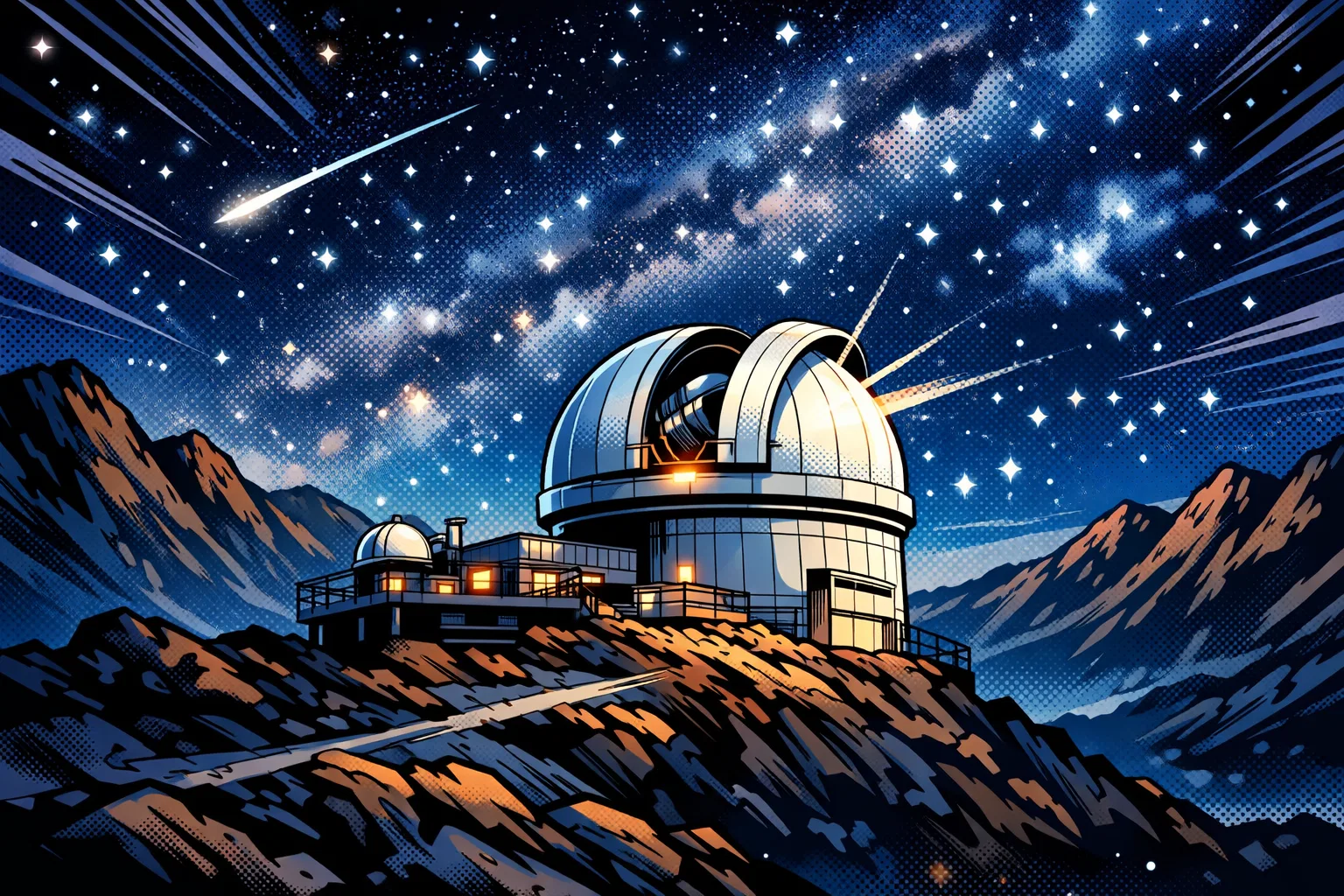
Saint-Barthélemy matters to Aosta Valley’s UFO story because it changes the question from “what strange lights have people reported?” to “what can a well-instrumented dark-sky site actually measure?” The Astronomical Observatory of the Autonomous Region of Aosta Valley and the Planetarium of Lignan sit above 1,600 metres in the municipality of Nus, in a valley known for unusually good night-sky conditions and public astronomy outreach.[Valle d'Aosta Observatory]oavda.itValle d'Aosta Observatory The FoundationValle d'Aosta Observatory The Foundation
That does not make the observatory a UFO investigation centre. Its importance is more practical and more useful: it gives the region scientific tools, trained observers and public education that can explain many skywatching surprises before they harden into folklore. Its work on asteroids, bolides and light pollution is especially relevant, because bright meteors, satellite passages, atmospheric effects and poorly judged distances are among the ordinary causes that can make honest witnesses describe extraordinary things. Italy’s Air Force procedure also points in this direction: a reported sighting is investigated for possible human or natural causes before being classed as unidentified.[Aeronautica Militare]aeronautica.difesa.itAeronautica Militare OVNIAeronautica Militare OVNI
Why Saint-Barthélemy matters
Aosta Valley is a mountainous region where the sky can feel unusually dramatic. Deep valleys, high horizons, dark nights, tourist viewpoints and clear winter air can all make a light in the sky seem sharper, closer or stranger than it would from a city street. Saint-Barthélemy adds something unusual to that setting: not just a place where people look up, but a place built to teach, measure and interpret the sky.
The observatory and planetarium are managed by the Clément Fillietroz Foundation. The foundation describes its activities as four linked areas: scientific research, education for schools, public outreach in astronomy and astrophysics, and technology transfer connected with research.[Valle d'Aosta Observatory]oavda.itValle d'Aosta Observatory The FoundationValle d'Aosta Observatory The Foundation That combination matters for a public-facing UFO history because it sits between two worlds that are often kept apart: local fascination with unusual lights, and disciplined observation of real celestial events.
The location is part of the story. Saint-Barthélemy, near Lignan, is high enough and remote enough to support serious stargazing, but still reachable for visitors. Italy’s official tourism site describes the area as a place where stars can be seen clearly with the naked eye and notes that the observatory combines public facilities with research projects, including asteroid work, solar studies, active galactic nuclei, extrasolar planets and Antarctica-related telescope work.[Italia.it]italia.itAstronomical Observatory of the Aosta ValleyAstronomical Observatory of the Aosta Valley
For UFO interpretation, the most important point is not that astronomers “debunk” everything. It is that they change the standard of evidence. A witness may sincerely report a silent orange light, a fast streak, a stationary glow over a ridge or a cluster of moving points. A scientific skywatching site asks different questions: what time was it, what direction, what elevation above the horizon, how long did it last, was it recorded by an all-sky camera, did other stations see it, and does the trajectory match a meteor, aircraft, satellite or atmospheric phenomenon?
That is a healthier frame for Aosta Valley than either credulity or dismissal. The region’s UFO record is scattered and often media-led; Saint-Barthélemy represents the local capacity to test some reports against astronomy, meteor monitoring and sky-quality data.
Dark skies change what people see
The Saint-Barthélemy valley received Starlight Stellar Park recognition in 2020, with reporting at the time describing it as the first Italian site to receive that designation. The award is linked to sky quality, protection and conservation, and the site’s continued status depends on ongoing brightness measurements rather than a one-off label.[euronews]euronews.comOpen source on euronews.com.
This is important because darkness cuts both ways. A darker sky helps people identify constellations, planets, the Milky Way and meteor showers, but it also makes some transient events more striking. A bright meteor seen over a black Alpine sky can look startlingly close. A satellite can seem more conspicuous than it would above a lit town. A planet low over a ridge can appear oddly intense when there are few competing lights.
The valley’s geography helps explain the darkness. Contemporary reporting on the Starlight certification highlighted the surrounding mountains, sparse population and limited public lighting as reasons why the sky remains relatively dark despite the broader problem of light pollution in northern Italy.[AFAR Media]afar.comMedia This Italian Valley Has Just Been Awarded a TopMedia This Italian Valley Has Just Been Awarded a Top This setting makes Saint-Barthélemy valuable for astronomy tourism, but it also means local sky reports should be read with attention to viewing conditions rather than treated as simple eyewitness descriptions.
A scientific study of the Aosta Valley observatory site reached a similar conclusion from the research side. Work on photometric observations from the Western Italian Alps found that its measured zenithal night-sky brightness was typical of very good, very dark observing sites, supporting the site’s suitability for precise astronomical monitoring.[arXiv]arxiv.orgOpen source on arxiv.org.
For UFO history, this matters because “I saw it clearly” is not the same as “I could identify it correctly”. Good visibility improves the quality of an observation, but it does not remove ordinary perceptual problems: judging distance without scale, mistaking angular motion for speed, or reading a light over a mountain as an object hovering above the valley. Saint-Barthélemy helps by giving the region a public language for these issues.
Bolide and asteroid monitoring
The most direct bridge between Saint-Barthélemy and UFO interpretation is the observatory’s work on asteroids and bolides. A bolide is a very bright meteor: a natural object entering the atmosphere that can produce a sudden luminous trail, fragmentation, colour changes and sometimes a spectacular flare. To a surprised observer, especially one without a reference point, that can look like a controlled object, an explosion, or a craft crossing the sky.
The observatory participates in PRISMA, the Italian network for systematic surveillance of meteors and the atmosphere. INAF describes PRISMA as a network of around 50 all-sky cameras used to observe fireballs, determine the heliocentric orbits of the meteoroids that caused them, and estimate possible fall zones for meteorite recovery.[oas.inaf.it]oas.inaf.itPRISM A project – INAF OAS BolognaPRISM A project – INAF OAS Bologna
The Aosta Valley observatory’s own asteroid and bolide project page gives a more local detail: its PRISMA camera is installed on the observatory roof, automatically records the brightest bolides, and officially began operating on 16 March 2017. The same page says the Aosta camera was the first in the Italian PRISMA network and that the observatory’s contribution has included hosting the camera and, in earlier work, providing mathematical tools for triangulation, orbit calculation, dark-flight modelling and fall-point estimation.[Valle d'Aosta Observatory]oavda.itValle d'Aosta Observatory Progetto Asteroidi e bolidiValle d'Aosta Observatory Progetto Asteroidi e bolidi
That is a major difference from ordinary anecdotal skywatching. A witness report may tell us that something bright crossed the sky at 10 pm. A camera network can compare records from different sites, reconstruct the path through the atmosphere and calculate whether fragments might have reached the ground. INAF describes the analysis of a fireball in four stages: triangulation, modelling the meteoroid’s physical parameters, calculating the dark-flight phase after the bright part ends, and deriving the object’s orbit before it reached Earth.[oas.inaf.it]oas.inaf.itPRISM A project – INAF OAS BolognaPRISM A project – INAF OAS Bologna
This does not mean every Aosta Valley sighting can be checked. A camera may be clouded out, the object may be outside its useful field, or a sighting may involve something too faint, too slow or too local for a bolide network. But where the phenomenon is a bright meteor or fireball, Saint-Barthélemy gives the region a way to move from story to measurement.
The observatory’s asteroid work gives the region a cosmic scale
Saint-Barthélemy’s relevance is not limited to meteors. The observatory is also associated with asteroid research and public education about near-Earth objects. Italy’s tourism site notes the discovery of an asteroid named Vallée d’Aoste among the observatory’s achievements, alongside participation in the discovery of exoplanets around XO-2S and the detection of more than one hundred variable stars.[Italia.it]italia.itAstronomical Observatory of the Aosta ValleyAstronomical Observatory of the Aosta Valley
This matters because public UFO culture often treats “objects from space” as a single vague category. The observatory separates that category into real, measurable things: asteroids, meteoroids, meteorites, planets, satellites, stars and galaxies. That distinction is useful for readers trying to understand regional sightings. A bright object may indeed have come from space, but that does not imply a craft; it may be a natural fragment burning up in the atmosphere.
Saint-Barthélemy’s Asteroid Day events show the same educational role. A 2024 Asteroid Day listing for the Planetarium of Lignan described an original show about risks associated with asteroids and other cosmic bodies whose orbits approach Earth, followed by a guided visit to a meteorite collection.[Asteroid Day]asteroidday.org10 asteroid day a saint barthelemy 29 june 2024 planetarium show10 asteroid day a saint barthelemy 29 june 2024 planetarium show The observatory’s 2026 Asteroid Day programme similarly included public discussion with a European Space Agency near-Earth-object specialist and regional civil protection representation.[Valle d'Aosta Observatory]oavda.itasteroid day 2026asteroid day 2026
For Aosta Valley’s UFO history, this is important because it gives the public a non-sensational way to talk about rare but real sky events. Meteors and near-Earth objects are not “nothing”; they are natural hazards and scientific targets. A serious explanation can still be fascinating.
Where science helps and where it cannot
Saint-Barthélemy should not be oversold as a machine that can solve every strange-sky story in Aosta Valley. It is best understood as a filter: extremely useful for some categories of report, limited for others.
It helps most when the report involves a phenomenon that is astronomical, atmospheric or visible over a wide area. Examples include bright meteors, fireballs, meteor showers, unusual planetary visibility, satellite trains, re-entering space debris and some weather-linked sky effects. The PRISMA network is especially useful because multi-station observations can reconstruct a bolide’s path, rather than relying on a single witness’s estimate of direction or speed.[Project STAND]projectstand.euProject STANDSt An D Camera Data now Available to All!Project STANDSt An D Camera Data now Available to All!
It helps less when a report is late, vague, purely verbal, or very local. A single light seen briefly behind a ridge may leave no usable record. A photograph without time, direction, exposure details or original metadata may be difficult to assess. A witness may remember the emotional force of the sighting but not the measurements that would make it testable. In those cases, the observatory can still provide likely explanations, but it cannot turn weak evidence into strong evidence.
This is where the Italian Air Force’s official framing is useful. The Air Force says reports are checked for possible correlation with human activity or natural phenomena, with the purpose of flight and national safety; only after checks fail to find a technical or natural explanation is an episode classed as an unidentified flying object.[Aeronautica Militare]aeronautica.difesa.itAeronautica Militare OVNIAeronautica Militare OVNI That is close to the most responsible way to read the Aosta Valley record: unexplained is a status after investigation, not proof of an exotic origin.
Saint-Barthélemy therefore weakens some UFO claims and strengthens others in a very specific sense. It weakens dramatic claims when a reported light fits a known meteor, satellite or astronomical event. It strengthens the region’s overall record by making it clearer which reports deserve attention because they survive the ordinary checks.
Aosta Valley’s UFO story looks different with an observatory in it
Without Saint-Barthélemy, Aosta Valley’s UFO history can look like a small archive of odd local stories: scattered reports, memorable press items and a few cases that remain unclear because the documentation is thin. With the observatory in the picture, the same history becomes more interesting. The region is not just a backdrop for sightings; it is also a place where the sky is actively monitored, interpreted and taught.
That changes the reader’s expectations. A claimed object over the Alps should be tested against meteor records, satellite visibility, aircraft routes, weather, viewing angle and camera data where available. A bright streak should raise the possibility of a bolide before anything more exotic. A cluster of moving lights should raise the possibility of satellites before a formation of craft. A stationary light near a ridge should raise the possibility of a planet, aircraft approach, reflection or misjudged distance.
The observatory also offers a cultural corrective. UFO folklore often thrives where mystery is left unexamined. Saint-Barthélemy shows that mystery can also be an entry point into astronomy. The Planetarium of Lignan, public observing terraces and guided skywatching make the same night sky that generates rumours into a place of learning. Italy’s tourism site describes visitor facilities including a heliophysics laboratory, an educational terrace with telescopes, a naked-eye “Star Theatre” experience and observing platforms for astronomy enthusiasts.[Italia.it]italia.itAstronomical Observatory of the Aosta ValleyAstronomical Observatory of the Aosta Valley
The most balanced conclusion is therefore neither “Aosta Valley’s UFOs are all explained” nor “the observatory proves something extraordinary is happening”. The better point is that Aosta Valley has an unusually useful contrast: a landscape that can produce striking reports, and a scientific institution that can explain many of them without mocking the witnesses. In a region where the UFO record is modest and uneven, that may be the most important contribution Saint-Barthélemy makes.
Amazon book picks
Further Reading
Books and field guides related to How Aosta's Observatory Changes the UFO Story. Use these as the next step if you want deeper reading beyond the article.
The UFO Experience
Focuses on scientific investigation of UFO reports and unexplained observations.
The Demon-Haunted World
Rating: 4.5/5 from 43 Google Books ratings
Examines evidence, skepticism and scientific reasoning relevant to UFO claims.
Astrophysics for People in a Hurry
Rating: 4.5/5 from 7 Google Books ratings
Provides the astronomy background needed to understand sky phenomena and misidentifications.
Cosmos
Supports understanding of astronomy and the wider context of observing the night sky.
eBay marketplace picks
Marketplace Samples
Live-tested eBay searches with available results related to this page.



Endnotes
1.
Source: italia.it
Title: Astronomical Observatory of the Aosta Valley
Link:https://www.italia.it/en/aosta-valley/astronomical-observatory-of-the-aosta-valley
2.
Source: euronews.com
Link:https://www.euronews.com/travel/2020/09/16/italy-s-saint-barthelemy-valley-in-aosta-is-a-paradise-for-star-gazers
3.
Source: afar.com
Title: Media This Italian Valley Has Just Been Awarded a Top
Link:https://www.afar.com/magazine/this-italian-valley-has-just-been-awarded-a-top-stargazing-award
4.
Source: arxiv.org
Link:https://arxiv.org/abs/1007.0252
5.
Source: oas.inaf.it
Title: PRISM A project – INAF OAS Bologna
Link:https://www.oas.inaf.it/en/prisma-project/
6.
Source: projectstand.eu
Title: Project STANDSt An D Camera Data now Available to All!
Link:https://projectstand.eu/stand-camera-data-now-available-to-all/
7.
Source: brera.inaf.it
Link:https://brera.inaf.it/en/progetti_ricerca/prisma/
8.
Source: indico.ict.inaf.it
Title: 01.Analisi Bolide Matera
Link:https://indico.ict.inaf.it/event/2601/contributions/16309/attachments/7493/15483/01.Analisi_Bolide_Matera.pdf
9.
Source: arxiv.org
Link:https://arxiv.org/pdf/1206.1729
10.
Source: arxiv.org
Link:https://arxiv.org/pdf/1007.0252
11.
Source: oavda.it
Title: Valle d’Aosta Observatory The Foundation
Link:https://www.oavda.it/en/the-foundation
12.
Source: aeronautica.difesa.it
Title: Aeronautica Militare OVNI
Link:https://www.aeronautica.difesa.it/ovni/
13.
Source: oavda.it
Title: Valle d’Aosta Observatory Progetto Asteroidi e bolidi
Link:https://www.oavda.it/portfolio-view/asteroidi
14.
Source: asteroidday.org
Title: 10 asteroid day a saint barthelemy 29 june 2024 planetarium show
Link:https://asteroidday.org/event/10-asteroid-day-a-saint-barthelemy-29-june-2024-planetarium-show/
Published: june 2024
15.
Source: oavda.it
Title: asteroid day 2026
Link:https://www.oavda.it/eventi/asteroid-day-2026
16.
Source: oavda.it
Link:https://www.oavda.it/fr/portfolio-view/apache-pianeti-extrasolari
17.
Source: aeronautica.difesa.it
Link:https://www.aeronautica.difesa.it/en/home/noi-siamo-l-am/organizzazione/lo-sma/
18.
Source: aostasera.it
Link:https://aostasera.it/eventi/asteroid-day-a-saint-barthelemy-due-appuntamenti-per-conoscere-i-pericoli-che-vengono-dallo-spazio/
19.
Source: tascapan.com
Title: the astronomical observatory
Link:https://www.tascapan.com/en/sight/the-astronomical-observatory/
20.
Source: ui.adsabs.harvard.edu
Link:https://ui.adsabs.harvard.edu/abs/arXiv%3A0911.3587
21.
Source: projectstand.eu
Title: Meteor Camera Kit
Link:https://projectstand.eu/meteor-camera-kit/
22.
Source: Wikipedia
Title: Unidentified flying object
Link:https://en.wikipedia.org/wiki/Unidentified_flying_object
Additional References
23.
Source: war.gov
Link:https://www.war.gov/medialink/ufo/release_1/255_413270_ufo%27s_and_defense_what_should_we_prepare_for.pdf
24.
Source: science.gov
Link:https://www.science.gov/topicpages/e/earth%2Bhazards%2Behaz
25.
Source: youtube.com
Title: I Can’t Explain It
Link:https://www.youtube.com/watch?v=iX5vTuo4Jxc
26.
Source: tripadvisor.com
Link:https://www.tripadvisor.com/Attraction_Review-g187863-d3696096-Reviews-Astronomical_Observatory_of_Saint_Barthelemy-Aosta_Valle_d_Aosta.html
27.
Source: italyformovies.com
Link:https://www.italyformovies.com/location/detail/16622/astronomical-observatory-of-valle-daosta
28.
Source: researchgate.net
Link:https://www.researchgate.net/figure/Flowchart-summarizing-the-main-tasks-and-corresponding-routines-performed-by-the_fig7_45927070
29.
Source: mindtrip.ai
Link:https://mindtrip.ai/attraction/lignan-valle-daosta/foundation-clement-fillietroz/at-X3V5iMPD
30.
Source: fripon.org
Link:https://www.fripon.org/prisma/
31.
Source: instagram.com
Link:https://www.instagram.com/p/DVYMSf-CJ0F/?hl=en
32.
Source: dbc.wroc.pl
Link:https://dbc.wroc.pl/Content/21788/PDF/23874.pdf
Topic Tree
Follow this branch
Parent topic
Aosta UFOsRelated pages 9
- 1947 Trail Did Aosta Have a UFO Story in 1947?
- 1970 s Clusters What Witness Groups Saw in the 1970 s
- 1985 Rai Case Was the 1985 Rai UFO Aosta's Best Case?
- Alpine Illusions Why Aosta's Mountains Create Strange Sky Reports
- Caveri Does a Named Witness Make a UFO Stronger?
- Cosmos Re entry When a UFO Becomes Falling Space Debris
- Official Counts Why Do Aosta's UFO Numbers Disagree?
- Photo Claims Can Aosta's UFO Photos Prove Anything?
- UFO Folklore Why Unidentified Does Not Mean Alien