Within Aosta UFOs
When a UFO Becomes Falling Space Debris
The 1967 fiery lights show how a dramatic Aosta sighting can later fit a known satellite re-entry rather than remain mysterious.
On this page
- The 18 July 1967 reports over Aosta
- The Cosmos 167 re entry explanation
- How re entries fool witnesses
Page outline Jump by section
Introduction
The 18 July 1967 Aosta sky scare is best understood as an explained UFO report rather than a lasting mystery. Local Aosta Valley reporting describes “strange fiery lights” over Aosta and says they were probably fragments of a “Cosmo” carrier or vector. That short note matters because it shows a recurring pattern in regional UFO history: a dramatic, alarming sighting can later fit the behaviour of falling space debris rather than an unknown craft. The detail also needs careful handling. The object often associated with the wider 1967 “Cosmos” explanation is not straightforwardly Cosmos 167 on that date: Cosmos 167 decayed on 25 June 1967, while a technical re-entry catalogue places a Cosmos 169 rocket-body re-entry over Europe on 18 July, including northern Italy and the Alps.[valledaostaglocal.it]valledaostaglocal.itufo dal 1947 ad oggi circa 80 avvistamenti in valleufo dal 1947 ad oggi circa 80 avvistamenti in valle
That correction does not make the Aosta report less useful. It makes it more useful. It turns the case into a small but clear lesson in how UFO archives should be read: witness descriptions, local memory, later summaries and space-object catalogues can point in the same explanatory direction while still disagreeing over the exact object name.
The 18 July 1967 reports over Aosta
The Aosta Valley reference is brief but vivid. A local retrospective list of regional UFO claims says that on 18 July 1967, in Aosta, “strange fiery lights” were seen in the sky, probably fragments of the “Cosmo” vector. In the same local sequence, the report sits between an August 1947 luminous trail from Pont-Saint-Martin to Mont Blanc and later 1970s and 1980s sightings, including the better-known 1985 Rai filming episode.[AostaCronaca]valledaostaglocal.itufo dal 1947 ad oggi circa 80 avvistamenti in valleufo dal 1947 ad oggi circa 80 avvistamenti in valle
For a reader, the important point is the wording. This is not presented as a close encounter, a structured craft, or a case supported by radar, landing traces, photographs or a formal investigation file. It is a remembered sky event: fiery lights, seen over Aosta, later judged likely to have been falling space hardware. That places it in a category common in UFO history but often less glamorous than “unexplained” cases: reports that were strange at the moment of observation because witnesses had no immediate way to identify what was crossing the sky.
The date also matters. A specialist list of visually observed satellite re-entries records a major event at 00:14 UTC on 18 July 1967 involving the rocket body of Cosmos 169. The reported sighting area stretched across England, France, the Netherlands, Belgium, Luxembourg, Germany, Switzerland and Italy, with Italy described as including the northern Alps and Bologna.[satobs.org]satobs.orgObserved re-entries #22.xlsxObserved re-entries #22.xlsx
That pattern fits the Aosta note better than a purely local phenomenon. A re-entering rocket body can be visible over a long track, so witnesses in separated places may report the same event in different local terms. In Aosta Valley, with Alpine horizons and dark mountain skies, a train of bright fragments could look especially dramatic: not simply a point of light, but a slow, burning procession crossing the sky.
The Cosmos 167 problem
The phrase “Cosmos 167” is tempting because it sounds precise. In fact, it exposes the main risk in this case: a correct broad explanation can be attached to the wrong catalogue number.
Cosmos 167 was a Soviet spacecraft launched on 17 June 1967. It is listed under international designation 1967-063A and NORAD ID 2852, with a decay date of 25 June 1967. Satellite-tracking data therefore do not support Cosmos 167 itself as the object that produced the Aosta 18 July lights.[n2yo.com]n2yo.comOpen source on n2yo.com.
A re-entry catalogue compiled by satellite observer Ted Molczan gives the same Cosmos 167 decay date and places its visible reports in Argentina and Paraguay on 25 June 1967. The same catalogue then lists the 18 July 1967 European event separately as Cosmos 169 rocket body, international designation 1967-069C, with sightings across western and central Europe and northern Italy.[satobs.org]satobs.orgObserved re-entries #22.xlsxObserved re-entries #22.xlsx
That distinction is not pedantry. In UFO history, exact dates, times and trajectories are what allow a case to be tested. “Cosmo” in a local article may have meant a Soviet Cosmos-series object in a loose sense. “Cosmos 167” may have entered later discussion as a convenient label. But if the reported Aosta date is 18 July, the stronger technical match is Cosmos 169’s rocket body, not Cosmos 167.
The safest wording is therefore: the Aosta 18 July 1967 “fiery lights” were probably caused by Soviet Cosmos-series space debris, most plausibly the Cosmos 169 rocket-body re-entry recorded over Europe that night. Cosmos 167 is relevant as a cautionary name attached to the story, but it is not the best match for the 18 July Aosta event.
How re-entries fool witnesses
A satellite or rocket-body re-entry can look unlike ordinary aircraft, stars or meteors. That is why these events have repeatedly entered UFO files. The Aerospace Corporation explains the broad visual difference in practical terms: natural meteors usually pass in a few seconds, while human-made re-entries are slower and may last around 20 to 90 seconds or more.[aerospace.org]aerospace.orgOpen source on aerospace.org.
That extra duration is crucial. A meteor often feels like a flash. A rocket body breaking up can look like a formation: several bright pieces moving along the same path, changing brightness, shedding sparks and leaving the impression of controlled motion. To a witness without prior experience of re-entry, a single object fragmenting in the upper atmosphere may appear to be many objects travelling together.
NASA’s orbital debris material explains the physical reason for this fragmentation effect. After a spacecraft or parent body breaks up, individual components continue to lose altitude and experience intense aerodynamic heating until they either burn up or survive to the ground. Materials matter: lower-melting materials tend to disappear higher up, while tougher components may last longer.[Orbital Debris Program Office]orbitaldebris.jsc.nasa.govOpen source on nasa.gov.
In Aosta Valley, the Alpine setting would have amplified the effect. Mountains can frame the sky so that direction and height are hard to judge. A bright object crossing above a ridge may seem closer or lower than it really is. If it fragments, the witness may remember not a technical “re-entry” but a row of fiery lights. That is exactly the kind of description later UFO lists preserve.
Why the explanation strengthened over time
The Aosta account is thin as a witness case, but relatively strong as an explained-scare case. Its strength does not come from detailed testimony. It comes from the fit between the local description and an independently catalogued re-entry over the same broad region and date.
Three points strengthen the prosaic explanation.
First, the Aosta report uses the language of fire and fragments, not a close, silent machine performing complex manoeuvres. Fiery fragmentation is exactly what witnesses often report during a decaying rocket-body re-entry.
Second, the event was not isolated to one valley. The 18 July 1967 Cosmos 169 rocket-body entry was recorded across several European countries, including Switzerland and northern Italy. That wide footprint is what one would expect from a high-altitude re-entry track, not from a local craft hovering over Aosta.[satobs.org]satobs.orgObserved re-entries #22.xlsxObserved re-entries #22.xlsx
Third, the Italian local article itself already leans towards an explanation, saying the Aosta lights were probably fragments of a Cosmos-series vector. That matters because the case has not survived chiefly as an unresolved mystery. It has survived as an example of how an originally strange sight can be placed into a known space-age category.[AostaCronaca]valledaostaglocal.itufo dal 1947 ad oggi circa 80 avvistamenti in valleufo dal 1947 ad oggi circa 80 avvistamenti in valle
The remaining weakness is the name. If a page, catalogue or retelling calls the Aosta event “Cosmos 167”, that should be treated as a loose or mistaken label unless it is referring to the separate 25 June 1967 South American re-entry. For Aosta on 18 July, the better match is Cosmos 169 rocket debris.
What this case teaches Aosta Valley UFO readers
The Aosta 1967 sky scare belongs in the region’s UFO history because it helps separate “unidentified at first sight” from “unexplainable after checking”. It is a reminder that UFO records are not just lists of mysteries. They are also records of public perception: how people describe unusual lights before astronomy, aviation records or satellite data catch up.
This is especially important for Aosta Valley because the region’s UFO record is modest and scattered. A few cases are memorable; many are brief local reports. In such a setting, an explained case can be as valuable as an unresolved one. It gives readers a practical test for other reports: did the event occur over a wide area, did it involve fiery fragments, did it last longer than a meteor, and does the date match a known re-entry?
Italy’s own official framing also supports this cautious approach. The Italian Air Force states that, after the 1978 wave, it was designated to collect, verify and monitor UFO reports; it classifies an event as unidentified only when no technical or natural justification can be found after checks. The Aosta 1967 event illustrates the opposite outcome: a case that sounds spectacular in local memory but becomes less mysterious when checked against space-object records.[Aeronautica Militare]aeronautica.difesa.itAeronautica Militare OVNIAeronautica Militare OVNI
The fairest conclusion is therefore not that the Aosta witnesses were wrong to be startled. They probably saw something genuinely striking. The point is that striking is not the same as unexplained. In this case, the best evidence points to falling Soviet space debris, with the exact catalogue correction favouring Cosmos 169’s rocket body rather than Cosmos 167 for the 18 July 1967 Aosta lights.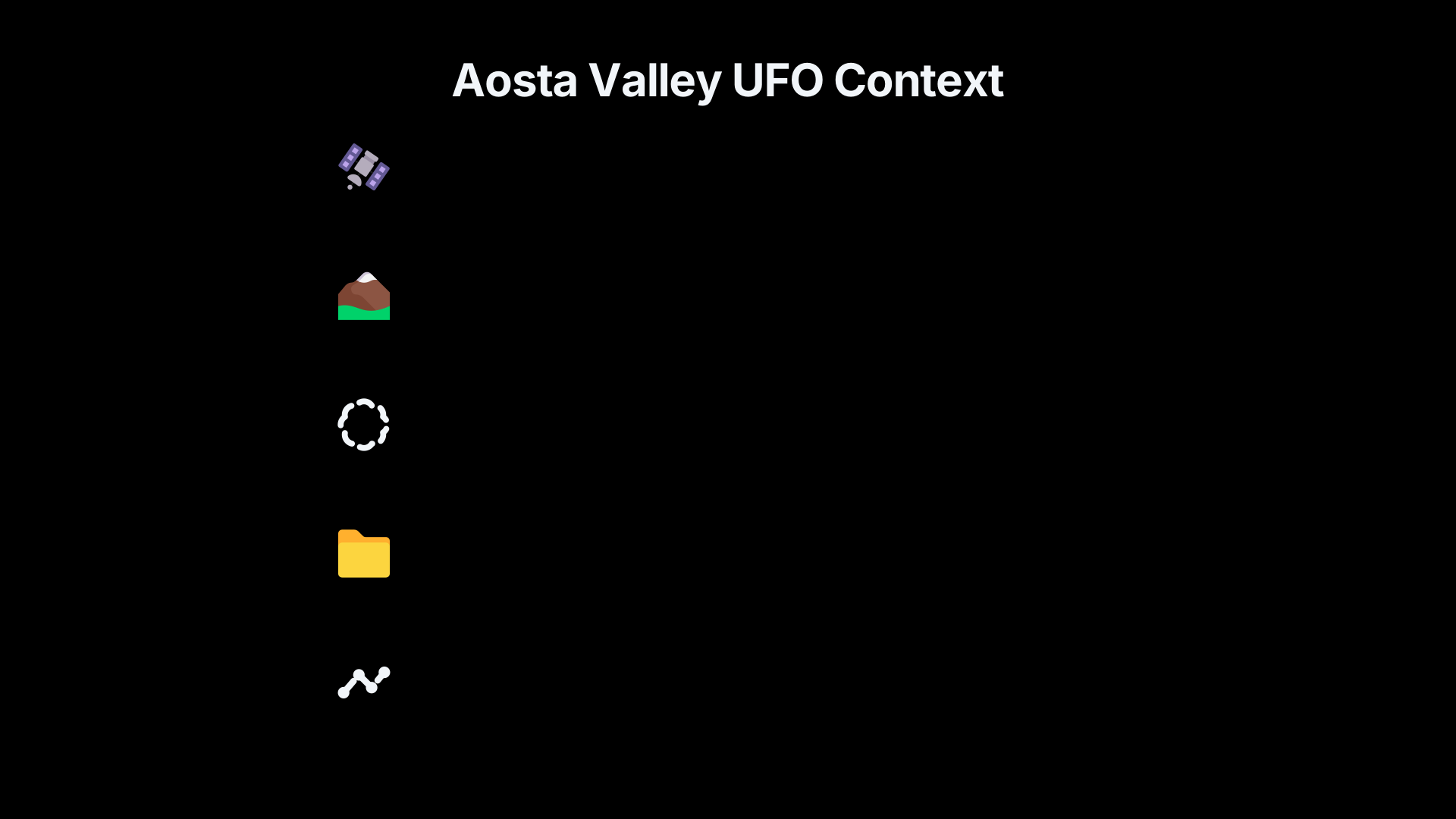
eBay marketplace picks
Marketplace Samples
Live-tested eBay searches with available results related to this page.

Endnotes
1.
Source: n2yo.com
Link:https://www.n2yo.com/satellite/?s=02852
2.
Source: satobs.org
Title: Observed re-entries #22.xlsx
Link:https://www.satobs.org/reentry/Visually_Observed_Natural_Re-entries_latest_draft.pdf
3.
Source: aerospace.org
Link:https://aerospace.org/article/what-does-reentry-look-like
4.
Source: orbitaldebris.jsc.nasa.gov
Link:https://orbitaldebris.jsc.nasa.gov/reentry/
5.
Source: nasa.gov
Title: Part 3
Link:https://www.nasa.gov/wp-content/uploads/static/history/SP-4225/documentation/mhh/mirhh-part3.pdf
6.
Source: nasa.gov
Link:https://www.nasa.gov/wp-content/uploads/2023/04/1967.pdf
7.
Source: ntrs.nasa.gov
Link:https://ntrs.nasa.gov/api/citations/20080022435/downloads/20080022435.pdf
8.
Source: heasarc.gsfc.nasa.gov
Link:https://heasarc.gsfc.nasa.gov/docs/heasarc/missions/cosmos.html
9.
Source: ntrs.nasa.gov
Link:https://ntrs.nasa.gov/api/citations/19980003950/downloads/19980003950.pdf
10.
Source: nasa.gov
Title: sp 4225
Link:https://www.nasa.gov/wp-content/uploads/2023/04/sp-4225.pdf?emrc=a2fef9
11.
Source: ntrs.nasa.gov
Link:https://ntrs.nasa.gov/api/citations/20170011662/downloads/20170011662.pdf
12.
Source: s3vi.ndc.nasa.gov
Title: Brito 2015 J. Phys. Conf. Ser. 641 012026
Link:https://s3vi.ndc.nasa.gov/ssri-kb/static/resources/Brito_2015_J._Phys.__Conf._Ser._641_012026.pdf
13.
Source: archives.gov
Title: Project BLUE BOOK
Link:https://www.archives.gov/research/military/air-force/ufos
14.
Source: archives.gov
Title: project blue book 50th anniversary
Link:https://www.archives.gov/news/articles/project-blue-book-50th-anniversary
15.
Source: aerospace.org
Link:https://aerospace.org/reentries/grid?field_reentry_sighting_value=All&format_select=table&order=field_mission&page=11&reentry_timezone_selector=Europe%2FMadrid&sort=asc
16.
Source: aerospace.org
Link:https://aerospace.org/reentries
17.
Source: valledaostaglocal.it
Title: ufo dal 1947 ad oggi circa 80 avvistamenti in valle
Link:https://www.valledaostaglocal.it/2014/03/01/leggi-notizia/argomenti/attualita-2/articolo/ufo-dal-1947-ad-oggi-circa-80-avvistamenti-in-valle.html
18.
Source: aeronautica.difesa.it
Title: Aeronautica Militare OVNI
Link:https://www.aeronautica.difesa.it/ovni/
19.
Source: aeronautica.difesa.it
Link:https://www.aeronautica.difesa.it/en/category/ovni/
20.
Source: aeronautica.difesa.it
Title: it OVN I
Link:https://www.aeronautica.difesa.it/en/2023/01/12/ovni/
21.
Source: agenziaentrate.gov.it
Link:https://www.agenziaentrate.gov.it/portale/documents/20143/6423924/5X1000-AF2023-%2BETS%2BE%2BONLUS%2B-%2BESCLUSI%2B-%2Baggiornati%2Bal%2B16.09.2024.csv/6860abc4-f126-bc68-7e9d-974a8206bc99
22.
Source: assets.publishing.service.gov.uk
Title: ufo report 2009
Link:https://assets.publishing.service.gov.uk/media/5a7582c440f0b6397f35efcb/ufo_report_2009.pdf
23.
Source: digitallibrary.un.org
Link:https://digitallibrary.un.org/record/822457
24.
Source: keeptrack.space
Link:https://keeptrack.space/space-terms/reentry
Additional References
25.
Source: youtube.com
Title: When NASA Tried to Build a REAL Flying Saucer | NASA’s Unexplained Files
Link:https://www.youtube.com/watch?v=uyjaSlGnxZo
26.
Source: youtube.com
Link:https://www.youtube.com/watch?v=y8VhvQTUk7c
27.
Source: spaceweather.gov
Link:https://www.spaceweather.gov/impacts/satellite-drag
28.
Source: science.gov
Link:https://www.science.gov/topicpages/a/ad%2Bhoc%2Bcode
29.
Source: youtube.com
Title: Fiery lights spotted in skies over Wisconsin believed to be’space junk’
Link:https://www.youtube.com/watch?v=kC5BkObM8Ig
30.
Source: archivesfoundation.org
Link:https://archivesfoundation.org/documents/50-years-ago-government-stops-investigating-ufos/
31.
Source: instagram.com
Link:https://www.instagram.com/p/DMIXFFARnUv/
32.
Source: scribd.com
Link:https://www.scribd.com/document/53297926/Did-you-know-that
33.
Source: facebook.com
Link:https://www.facebook.com/SpaceEngine/posts/did-you-know-that-51-pegasi-a-sun-like-star-has-an-exoplanet-which-was-first-fou/331653379202278/
34.
Source: facebook.com
Link:https://www.facebook.com/HISTORY/posts/during-the-cold-war-as-project-blue-book-investigated-potential-ufo-threats-a-sh/1473622884330683/
Topic Tree
Follow this branch
Parent topic
Aosta UFOsRelated pages 9
- 1947 Trail Did Aosta Have a UFO Story in 1947?
- 1970 s Clusters What Witness Groups Saw in the 1970 s
- 1985 Rai Case Was the 1985 Rai UFO Aosta's Best Case?
- Alpine Illusions Why Aosta's Mountains Create Strange Sky Reports
- Caveri Does a Named Witness Make a UFO Stronger?
- Observatory How Aosta's Observatory Changes the UFO Story
- Official Counts Why Do Aosta's UFO Numbers Disagree?
- Photo Claims Can Aosta's UFO Photos Prove Anything?
- UFO Folklore Why Unidentified Does Not Mean Alien